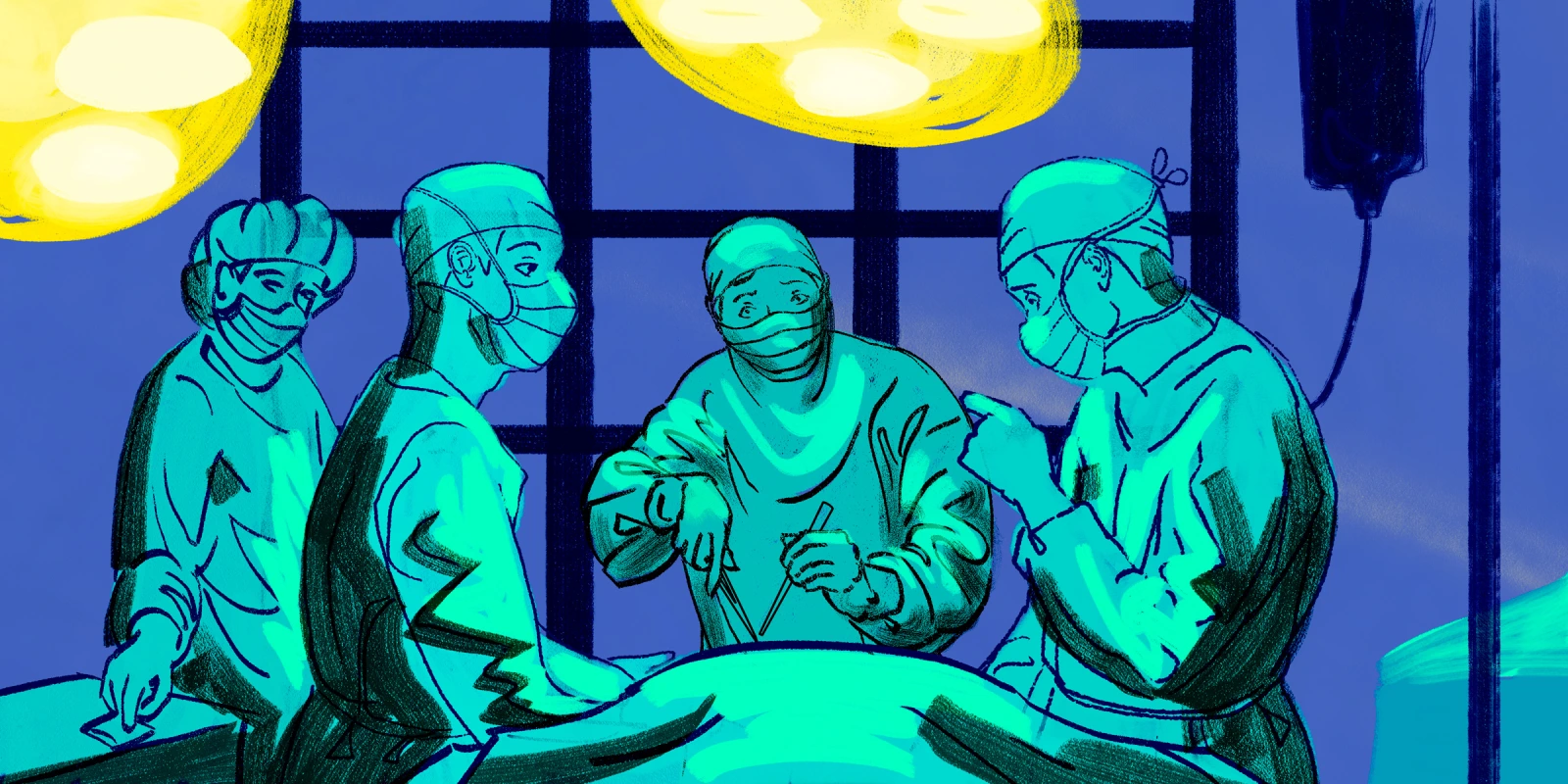

I could feel the sweat trickle down the back of my neck as I strained to position a clamp for the third time in “tiger country” anterior to the acetabulum. I had been working for hours to reduce the quadrilateral plate on the inside of the pelvic ring, fixing a protrusio anterior column acetabulum fracture in an obese patient. The geometry of the fracture and the angle of the clamp conflicted with each other, and the 3D anatomy of the region was challenging to hold in my mind.
I glanced up at the monitor where the CT scan was displayed to ensure that I was correct in my trajectory, and as I began to squeeze the clamp on what I hoped was the perfect location for anatomic reduction, the TV screen switched to black. Again.
Our healthcare agency’s HIPAA protocol only allows for three minutes of inactivity before the computer screen goes to sleep, and I had reached that point dozens of times during this surgery. Each time, the circulating nurse had to log into her account to renew the images while I waited. If you catch it early enough, a jiggle of the mouse will do. But if the screen completely goes dark, that requires a full log in.
At that critical point in the case when I needed the CT the most, the system failed me. I felt my blood pressure skyrocket. I wanted to scream expletives. I wanted to throw instruments across the room. My patience was gone.
In my 20-year career, I have witnessed extraordinary technological advancements, the best of these have been digital radiographic images and the EMR. We used to joke that an entire year of our orthopaedic residency program was spent chasing down X-ray folders back when there was only one copy of a patient’s file. Computerizing these important elements of patient care revolutionized the way we take care of patients, increasing efficiency and quality of care in ways that we never could have imagined.
But these technological advancements have also created obstacles that we never could have anticipated.
The EMR has made obvious improvements to our ability to document and store patient information. Our patient charts can be remotely accessed now from almost anywhere in the world with Wi-Fi. But this increase in remote access has created a paradox of decreased access at the times when information is the most needed: positioning the patient on the OR table, explaining X-rays at the hospital bedside, or anywhere in the hospital or clinic that is not literally right next to a computer terminal.
Recently, a surgical patient of mine received a regional block on the wrong arm. We had just completed a detailed pre-anesthesia time-out according to our hospital protocol, with all members of the care team at the bedside. In the time that it took me to walk to the computer in the back of the OR and pull up the elbow X-rays for the third time in anticipation of positioning, my patient received regional anesthesia on the incorrect extremity.
Could this have been prevented if the X-rays had not disappeared? We will never know.
The EMR has been arguably one of the greatest medical advancements of this century, but its enormous scope and universal design ensure that it is not the perfect tool for any one physician or service. I used to admonish my residents for scribbling brief notes in illegible handwriting that barely contained any clinical information. Now their notes are often cut and pasted from the previous day, inflated with autopopulated information that other physicians have entered into the system, propagating mistakes and making it difficult to determine what they examined and know about their patients.
The cognitive and emotional effort required to perform my daily work as an orthopaedic trauma surgeon is substantial, but the work is not what is burning me out.
It is the minutes I waste clicking through the EMR to figure out which metacarpal is broken when an inpatient follows up in clinic.
It is scrolling through pages and pages of progress notes to find my resident’s plan for the day, only to discover that it is the exact same plan as yesterday.
It is committing each patient’s medical record number to memory a hundred times a day so that when I toggle to my PACS, I correctly pull up their X-rays.
It is the human cost of searching.
What mishaps have you faced during surgery? Share in the comments.