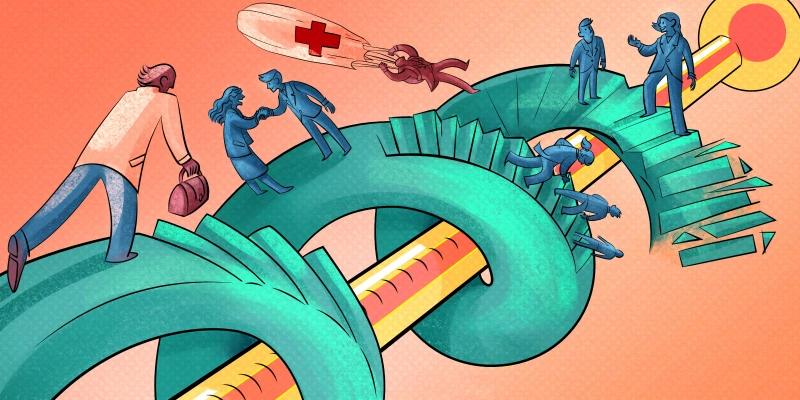

This year’s Kidney Week made one thing clear: artificial intelligence (AI) is no longer a side conversation in nephrology. It is becoming part of the specialty’s central discussion about how we interpret data, support decisions, and deliver care.
I had the privilege of co-moderating the Sunday session, “Will Artificial Intelligence Help or Replace Nephrology Professionals? Separating Reality from Fear.” The title captured a question many clinicians are asking. The discussion moved beyond the familiar promise of algorithms that predict kidney disease. Speakers addressed decision-making beyond prediction, support for patients and clinicians during kidney transplant evaluation, and the potential of foundation models and multimodal AI in precision nephrology.
The broader scientific program showed how quickly the field is expanding. Kidney Week featured dedicated AI sessions on clinical prediction and digital kidney care, kidney imaging and pathology, and AI in kidney care from pathology to prediction. The work ranged from machine-learning analysis of kidney biopsies and pathology images to tools to identify patterns in clinical records and support dialysis care. The range matters: kidney care generates information in many forms, and useful AI will need to connect those data with the clinical context in which decisions are made.
Yet the most important question is not whether a model can produce a prediction; it is whether that prediction helps a patient or clinician make a better decision. A risk score has limited value if it does not clarify which action to consider, when to take it, and for whom. Clinical usefulness also depends on whether a tool works in the populations and settings where it will be used. These are not technical details to address after deployment; they are central questions for evaluating the technology.
That distinction shaped my main takeaway from the meeting: nephrology needs to move from prediction to actionable, accountable decision support. AI should help clinicians see patterns, identify patients who may benefit from closer attention, and make complex information easier to use. The clinician still brings judgment about competing risks, patient goals, uncertainty, and the realities of care. As the ASN session description emphasized, AI can augment physician judgment, while human oversight remains essential.
The next phase will require more than promising abstracts. We need external validation, transparent reporting, careful assessment of bias and errors, and prospective evaluation of whether AI-supported workflows improve outcomes that matter to patients. We should also ask whether a tool saves time, adds work, or shifts the burden elsewhere. A model that performs well in a dataset may still fail to fit clinical practice.
Kidney Week also offered an opportunity to discuss these questions with colleagues across research, clinical care, and education. That exchange is important because AI is not a single product or specialty problem. It is a set of tools whose value depends on how they are designed, tested, and integrated into real decisions.
The conversation about replacement is understandable, but it is not the most useful question for kidney care. The more practical question is whether we can build and evaluate AI that helps nephrology teams deliver more informed, timely, and individualized care, while keeping clinicians accountable for decisions and patients central to them. Kidney Week 2026 showed that the field is beginning to ask that question in earnest. The work ahead is to answer it with rigorous evidence.
Dr. Cheungpasitporn has no conflicts of interest to report.