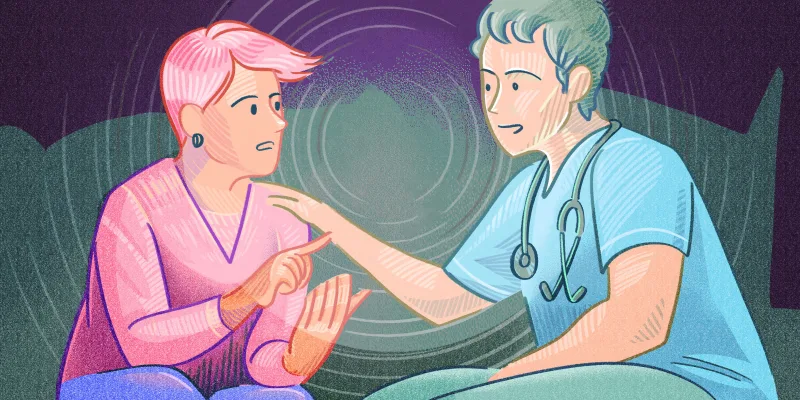

"Everyone tells me I'm better. But I don't feel like myself anymore."
Call him Daniel, a composite of many people I've cared for. Before schizophrenia interrupted his life, he was in school, going to the gym, texting friends, trying to become whatever version of himself adulthood might allow. Then came the first hospitalization. Then the second. Then the loop we know too well: crisis, admission, antipsychotic, stabilization, discharge, side effects, missed doses, relapse, admission again.
On medication, the voices got quieter. The paranoia loosened. His mother could sleep. The chart said he had improved. Then he told me he didn't recognize himself anymore. He had gained weight, stopped wearing the clothes he liked, and avoided the gym. Worse, he felt slowed, as if someone had placed a layer of glass between his thoughts and the world. In schizophrenia care, we treat symptom reduction as success, the finish line. Daniel was telling me it wasn't.
In psychiatry, I believe we got used to asking incomplete questions because we had incomplete treatments. For years psychiatrists asked: Are the hallucinations quieter? Is the paranoia controlled? Those questions still matter, but they reflect the tools we had, the dopamine-blocking antipsychotics that transformed our field and remain among the most important advances in modern medicine. Symptom reduction, though, is not recovery. It is the beginning of recovery.
Recovery, after all, is what patients ask for. They rarely demand lower PANSS scores. They want to finish school, return to work, play with their children, read a novel without losing focus, and recognize themselves again. One of psychiatry's greatest blind spots has been assuming those goals naturally follow symptom control. They don't always. Sometimes the illness stands in the way. Sometimes the treatment does: weight gain, sedation, cognitive slowing, emotional blunting, metabolic disease. We often call it nonadherence. Sometimes it is. Sometimes it is a patient negotiating for their identity.
That made me see one of psychiatry's newest drugs, xanomeline and trospium chloride, differently. What fascinated me about it wasn't the medication, but the question that created it.
Its story began not in schizophrenia but in Alzheimer's disease. In the 1990s, researchers studying xanomeline for cognition noticed something unexpected: hallucinations, delusions, and agitation improved. But gastrointestinal side effects proved too burdensome, and development stopped.
Most abandoned compounds stay abandoned. Years later, researchers revisited this one, pairing xanomeline with trospium to preserve the central muscarinic effects while limiting the peripheral ones. The result was the first FDA-approved schizophrenia treatment in decades to target cholinergic rather than dopamine receptors.
In 2024, Bristol Myers Squibb acquired the company that revived that molecule for roughly $14 billion. A compound once shelved as a failure became one of psychiatry's most valuable assets. Whether it changes practice remains to be seen. But it is changing how we think about prescribing: perhaps every new mechanism is also a new definition of recovery.
For decades, schizophrenia pharmacology has revolved around dopamine, and dopamine-blocking antipsychotics have saved lives. But are they enough? The next era is asking a different question: How do we preserve the person while treating the illness? Psychiatry is finally assembling the tools to answer it.
The first is mechanistic pluralism. Xanomeline and trospium chloride cracked the dopamine monopoly, but it is only the opening move. Researchers are pursuing next-generation muscarinic compounds alongside entirely different targets: TAAR1 agonists, glutamatergic modulators, and circuit-level strategies that reshape network dynamics rather than clamping down on a single receptor. Not all will survive Phase 3; emraclidine and TAAR1 candidates like ulotaront have already stumbled. But the direction has shifted toward prioritizing clinical signal over certainty and accepting that no single pathway explains an illness this heterogeneous.
The second is treating the body we've too often ignored. Daniel's weight gain wasn't a footnote to his recovery; it was central to why he stopped recognizing himself. For years we had little to offer beyond diet counseling that rarely worked. Now GLP-1 receptor agonists are being studied specifically for antipsychotic-induced weight gain, with early evidence of real benefit. If the data hold, patients may no longer have to purchase psychiatric stability with their physical health, preservation of the person in the most literal sense.
The third is precision, however imperfect. Psychiatry has long prescribed by trial and error. That is beginning to change as biomarkers and functional measures, reward-circuit testing, EEG-guided protocols, and neuroimaging are developed to match patients to mechanisms rather than chance. Symptoms once dismissed as untreatable residue are being reclaimed too. Anhedonia, the flat inability to feel pleasure, has become a transdiagnostic target, driving kappa-opioid antagonists aimed squarely at restoring the capacity for joy.
The fourth is a reopening of the door to consciousness. Psychedelic-assisted therapies, psilocybin foremost among them, are advancing through late-stage trials for treatment-resistant depression. The hype has outrun the evidence, and functional unblinding remains unresolved. But the ambition is telling: not merely to suppress symptoms, but to change how a person relates to their own mind.
None of these is finished, and some will disappoint us. But together they describe a field reorganizing around treating the whole person, not the loudest symptom. Every specialty eventually learns this. Cardiologists don't celebrate lower blood pressure; they celebrate because patients climb stairs without stopping. Psychiatry should celebrate when patients recognize themselves again.
For too long, patients have been asked to choose between stability and selfhood. Daniel does not want an elegant mechanism of action. He wants to think clearly, finish a semester, go to the gym without shame, and stop his mother from being afraid. He wants the voices quieter, yes, but not at the cost of disappearing from his own life.