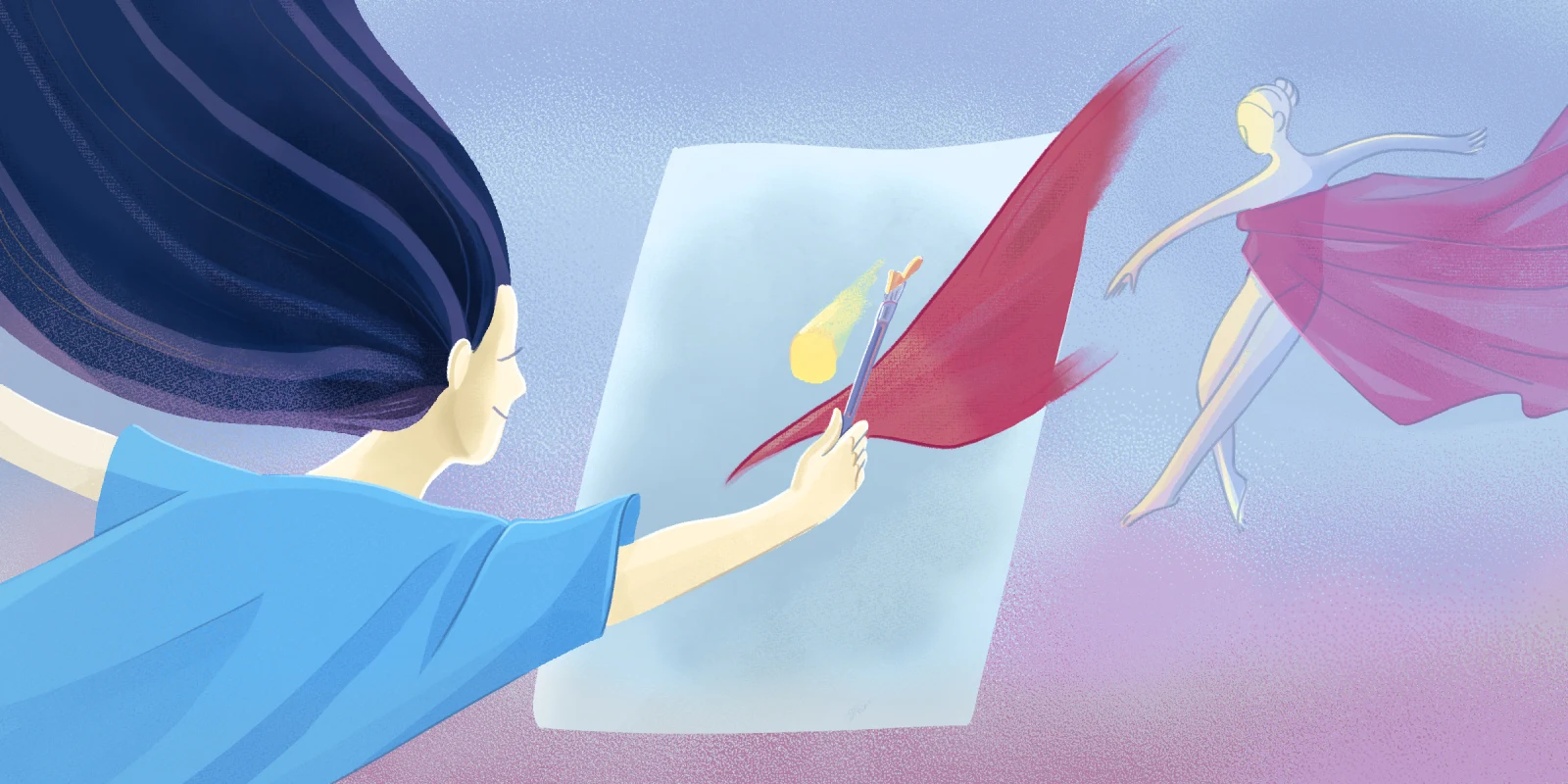
Before I was a medical student, I was an artist. One of the first photographs that remains vividly ingrained in my mind is of me at 5 years old, beaming widely as I cradle a box of Prismacolor pencils. Growing up, I saw art as an almost meditative process, an opportunity to focus acutely on observation. As I got older and joined the staff of the yearbook in high school, my love for art evolved as I discovered its value beyond a personal endeavor as a way of cultivating community. From drawing to digital media and graphic design, making art was a huge part of my life — but the deeper I got into my medical training, the more it stopped feeling like something I actively did, and more like a hobby I used to do. I wondered: Was it possible to be both an artist and a doctor-in-training?
The reason art stopped feeling so central wasn’t a lack of interest. It was that art wasn’t just a source of creativity, it was also a source of anxiety about how I was spending my time. As I trekked along in medical school, dedicating time to making art felt like a luxury, a trade-off. I found myself conflicted, choosing between time spent creating and time spent completing assignments, doing research, or being “productive.” And yet, the more involved my studies became, the more I began to long for the days when I could exist without pressure or deadlines. Whenever someone would ask what I enjoyed doing for fun, I would immediately cite art, but internally, I'd feel sheepish because it had been years since I had truly immersed myself in the practice. On the one hand, there was an internalized guilt about wanting to sit down and make art as a form of rejuvenation when there were other things I could be doing. On the other hand, there was also guilt for not pursuing what had once been so crucial to my identity.
Not long ago, these anxieties came to a head. A friend invited me to a figure-drawing session at a local studio, held on a day off of school. There was no goal or outcome from the session, simply three hours dedicated to observation and sketching. I wanted to accept the invitation immediately, yet I hesitated as the familiar guilt resurfaced. In medicine, we’re trained to prioritize efficiency and productivity — the opposite of what this session promised. I wondered whether three hours was too much time spent. But eventually, I recalled the meditative feeling of loosely tracing silhouettes across paper with charcoal and said yes.
When I first arrived in the studio, I treated the session almost like an assignment: the perfectionist in me — the one who spends so much time in class learning, making mistakes, and course-correcting — immediately wanted to hem and haw at the tiniest details as I mapped the figure in front of me onto paper. However, as the session unfolded, I began to abandon the desire to preserve every proportion, gradation in shade, and detail. The goal of this session was not to produce anything, but to simply do art.
Spending those three hours at the studio was liberating. In medicine, hobbies and personal interests tend to be framed in one of two ways: as something that can be leveraged in a clinical context (e.g., physician-writer, physician-musician), offering tangible skills that improve patient care, surgical dexterity, and communication; or as a means of work-life balance, a way of practicing self-care so that you can become more grounded and ultimately a better physician for your patients. However, neither perspective quite captures my relationship to the arts.
Attending the sketching session reignited my desire to continue creating without the burden of measuring up to some kind of outcome. Not long after the session, I signed up for a semester-long pottery class, an endeavor that humbled me considerably. With pottery and particularly its proliferation across social media, there is an inherent desire to produce finished products. I walked into my first class hopeful that by the end of the month, I'd have more than a handful of pieces to show for the time I spent. This was clearly not going to be the case: most of the clay I threw onto the wheel became my "reclaim" pile, a conglomerate of wet clay slip, trimmed scraps, and several pieces that teetered out of balance. Often, I'd reach the end of class with a glob of effort that had not become anything. But the image of the reclaim bucket feels fitting: what we do with time that doesn't "produce" does not just disappear — it becomes material for something else. I'm still figuring out what those hours become, and maybe that’s enough.
While I believe my engagement with the arts has sharpened my observation skills and attention to detail, and perhaps even my manual dexterity, I want to acknowledge that making art does not need to be justified by its clinical relevance or utility. Before medical school, when I first discovered the field of medical humanities, I was floored. It seemed a way to perfectly bridge my interests in arts, storytelling, and medicine — a way to engage in something clinically relevant while preserving a version of the art that brought me so much joy. However, over time, I've discovered that doing so often meant refitting my understanding of art within the framework of medicine. Art is something that I did long before I decided to pursue medicine. I believe there is value in so-called "unproductive" time, time that is not tied to any measure of output or efficiency. It sounds obvious to say that art does not need to be justified by its clinical relevance. However, I’ve realized enjoyment can sometimes be easy to talk myself out of, having spent several years in a system that ascribes so much value to output. This was a belief that I had quietly internalized.
We are encouraged to work smarter and find ways to be more efficient, particularly with high patient volumes and shortened appointment times. This mentality has evidently carried over to what I do and don’t do outside of school, in the clinic environment, and beyond. I hope to unlearn this mindset and return to the 5-year-old whose Prismacolor pencils meant the world to her, to end more days with dirty, charcoal-stained hands, and simply do art.
What's your relationship to art like these days? Share in the comments!