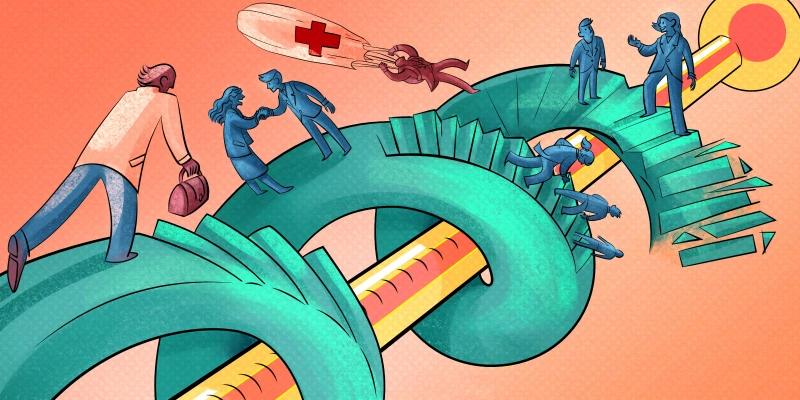

There was a time when patients accepted friction in healthcare because they had no reason to expect otherwise.
You know the drill: Call the office. Leave a voicemail. Wait for someone to call back. Download a form. Fill it out. Fax something. Schedule an appointment two weeks from now. Come into the office. Wait again. Eventually, if everything lines up, get a prescription.
Then direct-to-consumer (DTC) healthcare arrived.
Whatever physicians may think about the quality, marketing, or business models of some DTC companies, we should acknowledge one thing they have done extraordinarily well: They have taught patients that accessing certain types of medical care can be easy. A patient interested in weight loss can now encounter an advertisement while scrolling through social media, click a link, answer questions, complete an evaluation, enter payment information, and potentially begin treatment without ever picking up the phone.
That experience is changing patient expectations far beyond the companies providing it. And I believe that creates a problem for traditional medical practices.
I frequently hear physicians say, “I have a high-touch practice with a loyal patient base. I’m not in competition with DTC, trying to capture thousands of patients.” They’re missing the point. The question we should be asking ourselves is: How much friction will a loyal patient tolerate simply because they already know you? Increasingly, the answer may be: not much.
This is not unique to medicine. Consumers have been conditioned by Amazon, Uber, DoorDash, and practically every other industry to expect transactions to happen immediately and on their phones. Healthcare has been insulated from that expectation longer than most industries. Weight and wellness changed that. GLP-1 medications created enormous consumer demand at approximately the same time telehealth, online prescribing, digital payments, and home medication delivery became commonplace. The result is an entirely new competitive environment for physicians.
Patients still value the doctor-patient relationship. I would argue that relationships are our greatest competitive advantage. But a relationship does not excuse a poor experience.
If one option requires calling an office during business hours, completing paperwork, waiting for an appointment, and making several additional phone calls — while another allows enrollment from the couch at 9 p.m. — we should not be surprised when some patients choose the latter.
DTC competitors are not winning on clinical superiority. They are winning on convenience. DTC provides a frictionless enrollment process; your office doesn’t. And if your excuse is that you’re only brick-and-mortar and don’t offer virtual visits, it’s time to rethink that too. The unfortunate response would be to conclude that independent practices simply cannot compete. They can — but not by delivering 2026 medicine through a 2006 workflow.
There is another side to this transformation that gets considerably less attention.
As more money has moved into cash-pay weight loss, hormone therapy, peptides, and other wellness services, these programs have attracted more scrutiny from regulators, state medical boards, payment processors, advertising platforms, and others involved in the healthcare ecosystem. While the patient experience needs to become simpler, the infrastructure behind it is becoming more complicated.
Consider something as basic as knowing who your patient actually is: In a traditional practice, identity verification happens almost invisibly. The patient walks through your door, presents identification, and interacts with your staff. In a remote cash-pay environment, that assumption disappears. Telemedicine standards — a mix of HHS HIPAA guidance and state laws — increasingly require practices to think deliberately about identifying the patient, confirming where the patient is physically located, establishing an appropriate physician-patient relationship, and documenting the encounter.
Then there is informed consent. There is pharmacy sourcing (503A versus research-grade). Prescriber licensure. State-specific telemedicine requirements. Advertising rules. Recurring billing requirements. Privacy. Documentation. Payment processing.
Even the ability to accept a credit card may depend upon healthcare-specific certification and underwriting that most physicians never encountered when they opened a conventional medical practice. Did you know that your payment processor — Square, Stripe, PayPal, even your EMR payment processor — can shut down all of your payment processing if you violate Visa and Mastercard’s rules by not using a high-risk payment processor for card-not-present payments for services like medications? They can, and without any ability to appeal their decision.
This creates an odd paradox: The front end must feel effortless while the back end has to become increasingly rigorous. It’s up to a practice to do both for patients if it wants to keep them in the new DTC-led world.
In many ways, DTC companies identified genuine problems in healthcare and solved them. Patients wanted access, transparency, and convenience, and the market responded. But I am concerned that physicians will watch that happen and assume the only choices are either to continue violating many federal and state laws they’re not even aware of, or to concede these patients entirely.
There is a third option: Keep the physician-patient relationship. Keep continuity of care. Keep the ability to examine the whole patient rather than a single condition. But remove the unnecessary friction surrounding it.
A patient who already trusts their dermatologist, plastic surgeon, ob/gyn, internist, or primary care physician should not have to seek out a stranger on the internet simply because that stranger has a better enrollment process.
We should be able to offer both: the convenience patients have learned to expect and the longitudinal medical relationship physicians are uniquely positioned to provide. Doing that manually will become increasingly difficult. Not because physicians are incapable of prescribing these medications, but because what surrounds the prescription has changed.
The competitive advantage of the next generation of medical practices will therefore not simply be clinical expertise or technology. It will be the ability to use technology to make access easier for the patient while making compliance, documentation, and oversight more reliable for the physician.
DTC companies have already taught our patients what convenient healthcare can feel like.
They are not going to forget.
The question for the rest of us is whether we are willing to meet them there.