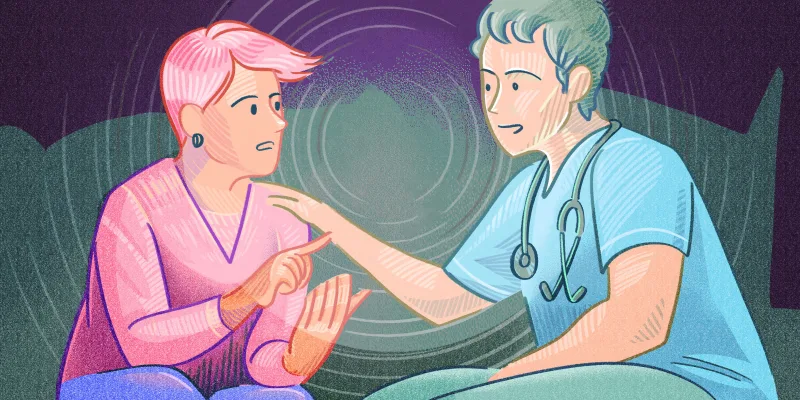

In October 2025, a patient transferred into my care after a recent hospitalization in August for suicidal ideation. The patient, Mr. C, a Mandarin-speaking man, was in his mid-40s. He was married and lived with his mother and his two children in public housing in Manhattan. He used a motorized wheelchair due to advancing muscular dystrophy. The chart mentioned that his depression was accompanied by "psychotic features" — he had a fear that people on the street were following him and out to get him when he left his apartment. This was his first depressive episode.
As with any new patient, a key question arose around his illness — what had changed in his life recently that led to this specific presentation? Mr. C shared with me that a few months ago, in the middle of July, his wife had presented for her green card interview in New York City and was arrested on the spot by ICE. She had walked into the country illegally over 20 years ago, and despite her husband being a U.S. citizen and going through the right channels to pursue green card status, ICE made the decision to detain. She had been stuck in a detention facility in rural Louisiana ever since. Her lawyers had thought that maybe a resolution would come within a month, but one month had turned into four.
In the meantime, Mr. C was in utter despair. Back in July, after his wife was taken, he suddenly developed thoughts of wanting to kill himself. He called 911 to report his concerns, and he spent multiple weeks admitted to our inpatient psychiatric unit. Now frequenting my office every two weeks, he shared that he continued to worry about his wife every day. He was able to speak to her over the phone, but their calls were filled with the anguish of not knowing what would happen next. He began to wonder if she would ever be let out of detention. Given his physical limitations, his wife had been the family's primary breadwinner, working in a restaurant and supporting their two children, aged 12 and 19, and his 81-year-old mother. Since July, he had worried constantly about how he would stitch together disability payments and make ends meet for his family. He rarely left his apartment, afraid that he might be targeted as well.
As Mr. C's clinician, I felt at a loss as to how to properly help him through his crisis. He was on an antidepressant for his mood symptoms and a low dose of an antipsychotic for his psychotic symptoms, but the fundamental root cause of his distress remained — federal immigration authorities detained his wife and refused to explain when or how she would be set free.
While many patients face life circumstances that are difficult for their doctors to correct, this situation felt acutely out of my control. But it also felt like a struggle where my voice mattered. Regardless of one's views on immigration enforcement, the clinical reality is that this detention created a cascade of mental health crises: acute suicidal ideation requiring hospitalization, new-onset psychosis, and ongoing severe depression and anxiety in a previously stable patient. The human cost was undeniable.
In trying to call attention to Mr. C's situation, it struck me how poorly equipped doctors are to help our patients in conflicts with ICE. If someone lacks housing, we can help them apply for vouchers. If a patient won't leave their home, we can contact a mobile crisis team. But if a patient's wife is scooped up and detained in Louisiana, there is often no number to call.
And if the pace of ICE's actions continues to pick up, this situation is only going to grow more dire, not only for those detained but for their families as well. Mr. C’s suffering is far from unique. As of September 2025, ICE holds nearly 60,000 immigrants in detention facilities — a 50% increase from just nine months prior. A recent survey found that about one-third of immigrants overall have experienced negative health repercussions due to worries about their own or a family member's immigration status.
What we're learning about family separation is deeply concerning. Studies demonstrate that children and caregivers impacted by family separations experience significantly higher rates of anxiety, depression, and post-traumatic stress disorder. A 2024 systematic review found that immigration detention is associated with elevated rates of depression, PTSD, and suicidal ideation — particularly among children and adolescents who have had a family member detained or deported. The trauma extends beyond those directly detained: children exhibit sleep disturbances, separation anxiety, regression, and crying spells — classic PTSD symptoms — after a parent's detention. In the case of Mr. C’s family, his own 12-year-old son had started to show concerning signs of defiant behavior and unstable mood at school after his mother was taken in.
The financial fallout makes everything worse. Families report that detention and deportation of family members often occurs suddenly and unexpectedly, leaving them in shock and financially unprepared. The sudden loss of income has families struggling to pay for rent, food, and utilities. In some cases, older children abandon plans to attend college to support the family. Money troubles pile on top of the emotional crisis, and families spiral deeper into anxiety and despair.
As clinicians, we need to develop a toolkit for responding to cases like Mr. C's. Who can we contact to help advocate for our patients and their families? We need clear protocols for documentation, and hospitals should compile referral lists for immigration legal aid. We also need training on how to recognize and treat detention-related trauma.
The issue goes beyond the hospital. Clinicians need to collaborate more closely with schools to identify mental health concerns in children of immigrant detainees. And professional organizations should create position statements recognizing detention-related trauma as a public health concern.
In addition, clinicians must develop a common vocabulary for documenting and screening for immigration-related health events. One such group, Physicians for Human Rights, has published a guide explaining what physicians need to know in these cases; we can look to them for an example.
Ultimately, our clinical notes may be some of the only documentation of the human cost of these policies. When we write about a patient's new-onset depression following a spouse's detention, when we document suicidal ideation that emerges after a family separation, when we prescribe antipsychotics for paranoia rooted in legitimate fear — we're watching a public health crisis play out in our exam rooms. As these stories become more ubiquitous, we must continue to report on how detentions are impacting the mental health of our patients, both so we can better understand the emotional impact on families and so we can communicate the rising toll to the broader public.
Mr. C continues to come to my office regularly. I adjust his medications, we talk about coping strategies, and I document his ongoing suffering. But each week, his wife remains in detention, and each week, I am reminded that some of the most significant threats to my patients' health lie far outside the reach of my prescription pad or my therapy sessions. I find myself questioning where my role as a psychiatrist ends — at the edge of the clinic, or in the policy spaces that create these crises? Until we develop better tools to respond to these crises and establish effective channels for speaking out, patients like Mr. C will continue to fall through the cracks between clinical medicine and policy enforcement — with devastating consequences for their mental health.
Dr. Brendan Ross is a psychiatry resident in New York City. He enjoys reading, writing, and spending as much time as possible outside. Dr. Ross is a 2025–2026 Doximity Op-Med Fellow.
Image by sdominick / Getty Images