
This month is National Poetry Month, and while you don't have to read a single poem to become a physician, it might benefit us all. Nearly every patient interaction I have is steeped in simile and metaphor — how else to express one's corporeal experience to another?: My chest pain is like an elephant on my chest. It's as if someone is knocking from the inside of my skull. Language is the tool we use to make our experiences known to one another. For the clinician, it can also be a valuable tool for reflection.
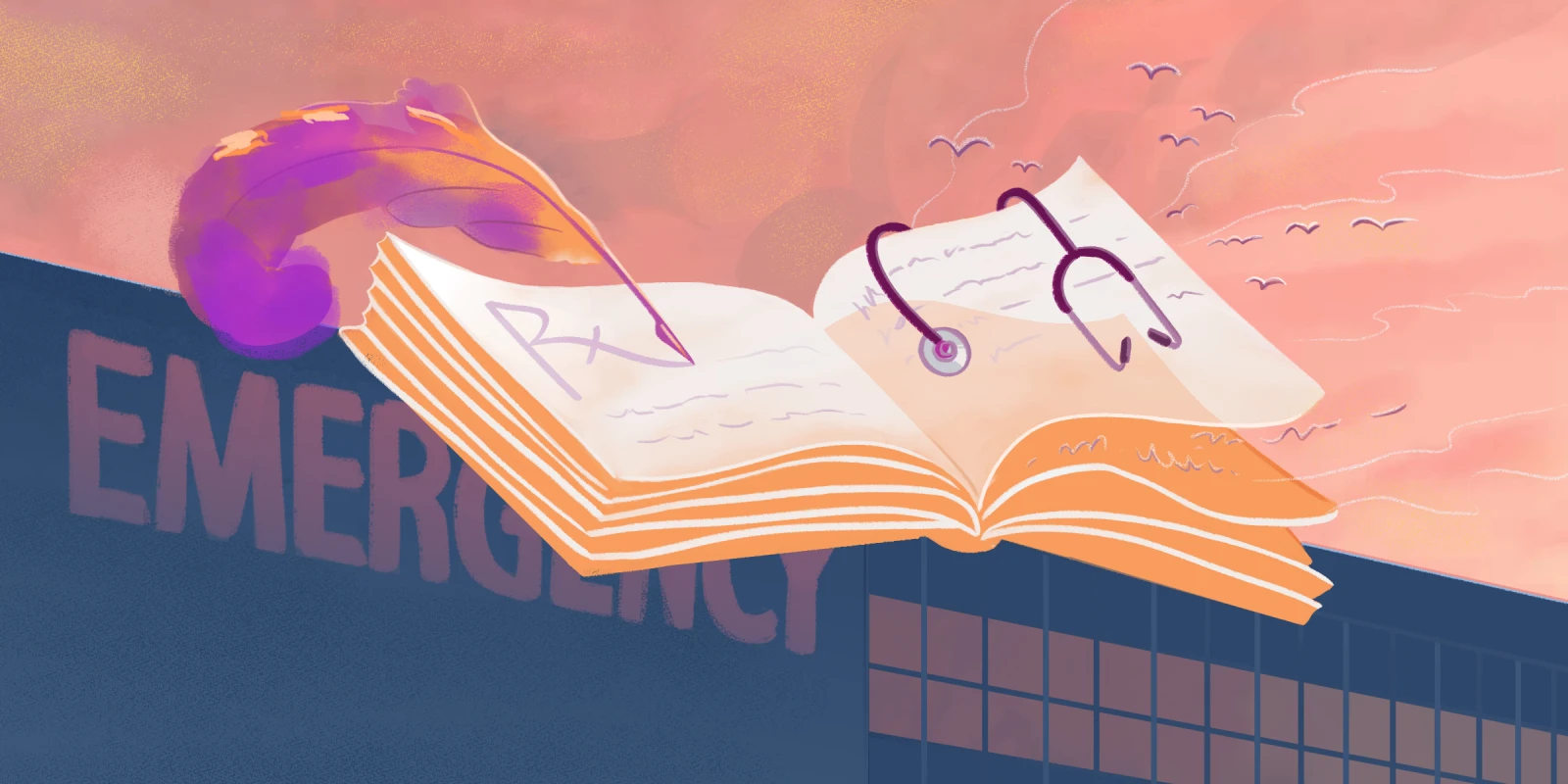
In Danielle Ofri’s essay titled “Poetry in Medicine,” she writes of sharing poems with her residents and patients on rounds. She ultimately concludes: “There’s no special magic in poetry, just as there’s no special magic in so much of our medical treatments. But sometimes I just want to give an Rx and see what happens: Take two sonnets and call me in the morning.” I agree with Dr. Ofri. There is no single poem that will cure a patient, or clinician, but, just as she posits that sharing poems on rounds nourishes a human connection, I think poetry has the power to make us better clinicians if we let it.
From the clinician perspective, poetry transcends the hard-earned, yet rigid, linguistic boundaries that years of medical training have gifted us. My favorite poems written by clinicians are subversive in their accessibility, as if performing a magic act: see the human behind the white coat. Take Rafael Campo’s “The Chart” or Fady Joudah’s “Progress Notes.” They demand that the reader acknowledge the humanity of both patient and clinician.
So, what has poetry done for me? When I sit down to write a poem, I rarely know what it is I'm going to write about. The act itself is an act of discovery. What needs to be said, or, more telling, what has not been said before. There are certain milestones in medical training that are bereft of awards, applause, or recognition. Think of the first medical decision you made on your own, the first time you pronounced a death, the first time you told a family their loved one was gone, or the first time you felt that stagnant moment in time when you saw a human suffering, and despite that medical degree, had nothing to offer but your presence. The first death; the first birth. I've written poems about all these occasions. Now, though, I write mostly about my days in the ED, how violence (both the type we inflict and the kind that seems to choose the best of us at random) and humanity reside like patients in a shared room, the curtain drawn between.
Poetry thrives on tension, and if there is a universe that exists, day after day, with more tension than a busy ED, more lives getting shaped, imperceptibly shifted or conspicuously collapsing, while life outside stubbornly moves on, I haven't found it.
There is perhaps no one more than myself for whom I am trying to arrange these parallel universes (think Susan Sontag’s kingdom of the well and the sick) into one to inhabit and one to make sense of. The first time I told a family their loved one had died was my second year of residency. It was a tragic accidental drowning in the zenith of summer that poetry helped me process.
Thinking back on that day, I wrote, “The best way to deliver news is the same way we all want to die — quickly. Shut the door and let them scream a hot yowl of grief. It's not the mind that grief goes to first, but the body (like a single nerve grief traverses) that sinks to the floor. I was thinking about the four walls that hold a body like water in a pool. The deep blue of a deep end. Another summer day." The discordant emotions evoked by the swimming pools of my childhood, the idle laziness of a summer day on repeat, and my new responsibilities as a clinician delivering news no one wants to hear were only fully realized and recognized through poetry.
The longer I practice and continue to write poetry, the more I’ve also recognized it as a mechanism for paying respect to my patients in a way that a typical shift in the ED can’t accommodate. In the most self-serving light, it can be thought of closure for myself, a kind of confessional box of forgiveness for allowing anything so life-altering and debilitating as a stroke, heart attack, or death, to become commonplace. When I take time outside of work to reflect, it also becomes an exercise in empathy, building a reflex, if you will, that extends to my time on shift. How could I have been a better physician for this patient, what is it that I wanted to say, would have said, if I had the words? Of a busy afternoon-turned-evening-turned-day, I wrote:
“I’m sorry I forgot about you — frankly, I’m embarrassed the sun set
before my thoughts could turn, that the night slipped into something thick
I could dip a spoon in, that the pages for standard motor vehicle collision ran across my beeper
like a bored marquee like anything could be standard, the way a body breaks.”
The art of a poem lives almost as much in what is written as what is not. It breathes in the pauses between lines and stanzas, a word or world anticipated and then replaced. A poem can be read much like a patient: three different clinicians with three different interpretations. That is to say, they are both forms of art: feeding into one another, not just deserving, but insisting, that we take a moment to reflect and listen. I promise it, no, I prescribe it: you and your patients will be better for it.
Interested in sharing your own poetry with the Doximity audience? Submit to the Medical Humanities vertical here.
Liana Meffert is an emergency medicine physician in Wisconsin. Her writing has been featured in JAMA, The Lancet, The Maine Review, SWWIM, and X-R-A-Y, among others. You can find more of her work at LianaMeffert.com. All views expressed are her own. Dr. Meffert is a 2025–2026 Doximity Op-Med Fellow.
Illustration by April Brust