
“I just want to feel the sun again,” a patient remarked to me after three weeks spent entirely indoors on our inpatient psychiatric unit.
As a member of a profession that strives for healing and recovery, I cannot help but notice that our treatments are often offered in relatively counterproductive settings. Our inpatient units, locked and stripped down for safety as they are, rarely allow space for fresh air or a walk outside. Beyond the hospital walls, it’s not much better. Our therapy appointments increasingly occur over video or in windowless offices, far from natural environments as well.
We can adjust medications, refer patients to therapy, or make a safety plan, but we can’t overlook the fact that the physical spaces in which we practice may have a deleterious effect — not just on our patients, but on ourselves as well. A nurturing environment likely directs healing and recovery as much as anything else, and yet, in the mental health field, time in nature is hardly prioritized.
I believe it’s time to change that. As psychiatrists, we must strive to creatively connect our work back to the ecology around us. The more we learn about our minds and bodies, the more a deep connection to the natural world becomes essential. And our recommendations don’t have to be one size fits all: diverse activities like walking in a forest, gardening, or simply sitting for 10 minutes in a park would all likely act on an overburdened nervous system. While more robust research needs to be done, the evidence in favor of nature exposure is clear: one 2019 narrative review found that it could reduce stress, decrease blood pressure, and boost the immune system. And fortunately for us in psychiatry, our patients — unlike the medicine patients confined to IVs and hospital beds — are often readily able to move and engage with nature.
That said, there are undeniable barriers to utilizing natural spaces for psychiatry patients. No hospital wants to be responsible for a patient running off or hurting themselves outdoors, for example. However, I believe that with the right guardrails and supervision, providing humane outdoor spaces can help patients recover during their stay in the hospital. Facilitating these spaces can also help patients cope with being in the hospital, and research shows that spending time outdoors is associated with reduced rates of depression, which may mean that patients who go outside are less likely to push against the guardrails of an inpatient setting, or to enact violence or self-harm.
The idea that “nature is healing” is not new. Historically, many psychiatric and long-term stay hospitals existed in bucolic settings, and a mental health crisis would involve a stint in the countryside. Today, however, following the deinstitutionalization movement of the late 20th century, many of those grand campuses have been shuttered or abandoned. If someone wants to recover while surrounded by trees, they should be prepared to have boutique insurance. Nature these days has become a luxury, not only in hospital settings, but in general: across U.S. cities, low-income neighborhoods routinely have a lack of access to green space.
Building nature back into our clinical spaces may seem like a demanding endeavor, but it’s not as difficult as it may appear. Many of our largest inpatient psychiatric institutions have extensive grounds that receive little use, though some, including Creedmoor, which occupies around 300 acres, have worked to allow patients daily time outside. Even within urban settings, we can work to grant patients unimpeded, regular access to green spaces such as interior courtyards or gardens, and ensure that these spaces are appropriately staffed.
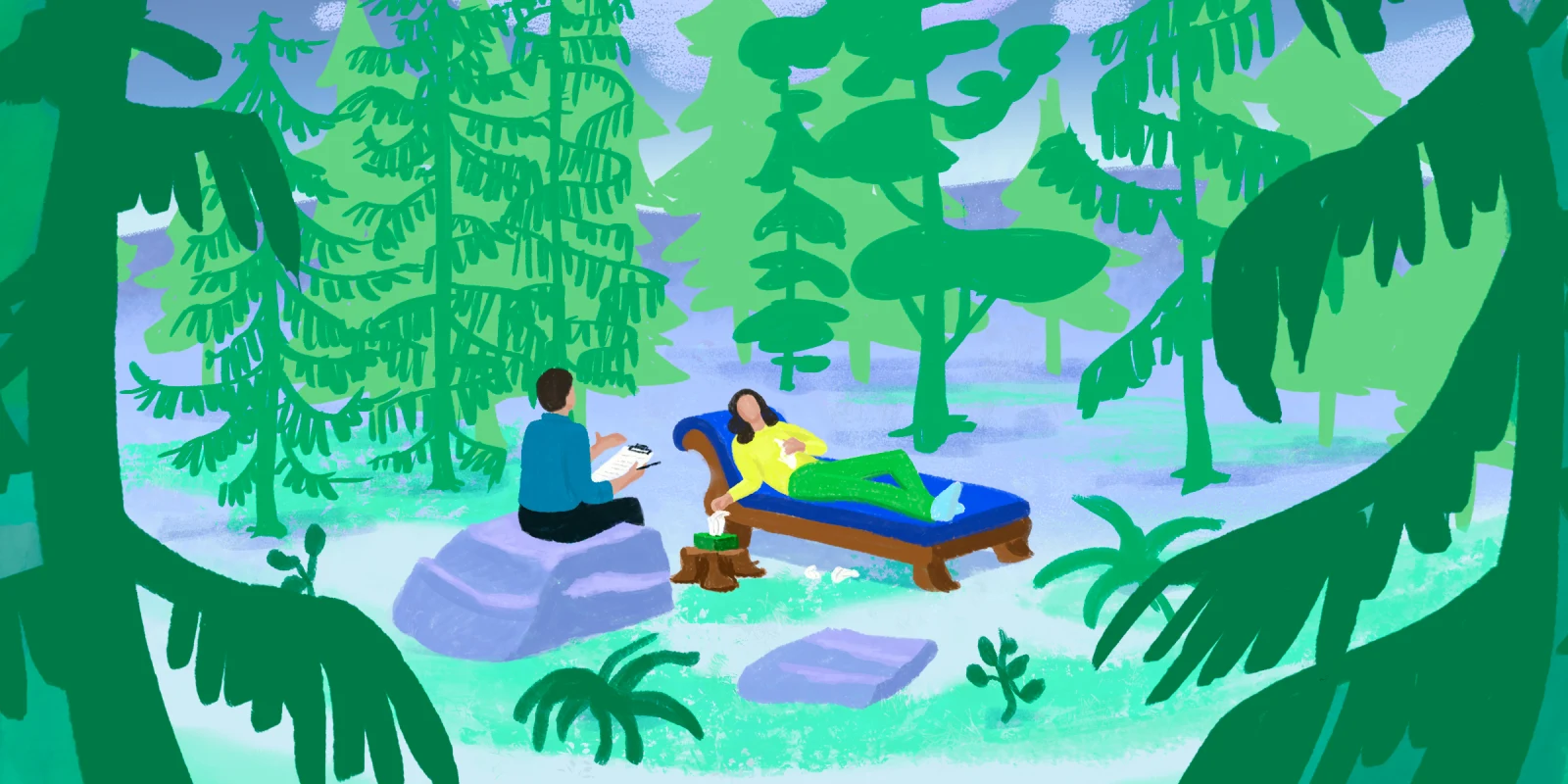
Outside the hospital, there are even more opportunities for creativity. Perhaps it is time we start to rethink the medium and not just the message. If we allow nature to mediate our interactions with patients, we may find that we ourselves are more capable of listening. It has been shown that the multi-dimensional sensory stimulation of a forest lowers anxiety and distraction — what if we joined our patients (either on the phone or in person) on the walks we encourage them to take?
This is already happening: Recently, The New York Times reported on therapists providing therapy sessions over a stroll in the woods. Even if we can’t join our patients physically, I wonder whether, given the ubiquity of tele-visits in the current landscape, we could see them virtually during a session mostly spent outside. Once we’ve finished a brief on-screen check-in, why not transition to audio and listen to a patient while walking? Some of the closest listening I do happens while walking, and I find that peak attentiveness is rare when on video calls. And if for myriad reasons, institutional or personal, going on a nature walk is not possible, we can perhaps conclude sessions by sending our patients to the park. Some doctors in Canada have even begun to prescribe national park passes.
Elsewhere, healers have long understood what medicine seems to have forgotten. Vipassana meditation retreats are generally located well outside of cities, in places with walking paths, surrounded by trees and fresh air. The Japanese tradition of forest medicine, the practice of harnessing the restorative power of woodland environments in healing, has steadily been gaining ground in integrative health and immunology for decades. Immunologists in Japan have recently been studying biomarkers in patients who take these therapeutic forest walks or go “forest bathing.” We need not wait for nature-grounded treatments to arrive; we can begin asking for them now.
There are barriers to making any of this happen: patient safety, privacy and confidentiality, and the difficulty of establishing a consistent, stable frame. But without dismissing these barriers, I believe we can accomplish our goal safely, provided the right protocols and staff are in place. On confidentiality, outdoor sessions require advance planning around populated areas; on safety, patient selection matters enormously. Even my residency cohort’s internal process group has struggled to step outside, as concerns about keeping our discussions confidential and consistent persist. But it often feels like we are looking for reasons it can't work, rather than asking how it could. These are solvable problems for the right patients in the right contexts. The question worth asking is not whether nature-based care is perfect, but why we continue to disregard something whose benefits we've already seen. If safety is the main reason, I argue that long weeks spent inside are ultimately making our patients less safe.
While we contemplate the value of outdoor time, more and more of our clinical encounters are happening indoors, mediated through technology. The further we are alienated from nature, the further we are alienated from ourselves. Can we really heal and be healed in these conditions? Of course, more research into green-scaling psychiatric care must be done, but the early evidence of the positive effects of what some researchers call “nature dosage” is compelling. As psychiatrists, we must lean into nature as a positive example of what makes us whole, and perhaps return to our patients, and to ourselves, a little more of the sun.