In the 25 years that I have been in the medical world, I have seen the advent of technology, attempted to cling helplessly to tradition, and struggled to resolve the two. I have watched de-identification lead to depersonalization, have noted that writing a prescription would be a lot easier on paper, and have also realized how much of what we used to publish on that same paper was outdated before the ink was even dry. It has also become clear that there is just too much information for a nonmachine world, and the gigabyte train has long left the station. Still, while medical information exists in ever-increasing boundless quantities, only made sensible by computer processing, it simultaneously lives in a tech vacuum that omits the one basic thing that we need more than all else: feeling.
When I was in medical school, senior surgeons bemoaned the lost art of examining a patient. They passed around “Cope’s Early Diagnosis of the Acute Abdomen,” showing us that a really good doctor can listen to their patient, examine them with expertise, and figure out what is wrong, with no labs and no imaging, about 95% of the time. Half of the residents listened and bought the book, then spent the rest of their careers hoping they were “that” doctor. The other half logged in to the computer to “verify” their presumptive clinical diagnosis and never learned how to feel the words they were reading about because they had no actual patient contact. Today, little is found until the machine tells us it is there; and many things are found late, because they cannot be identified until they can be seen through electronic eyes.
During my trauma rotations as a surgical resident, we had paper charts, which required us to go to the nurses’ station to write any single order. It was a strain and a bother, and we rued each trip up and down the stairs from one unit to the next. But it also offered us the chance to communicate directly with the team, get other updates that we were not expecting, and remember things that we had also meant to do. Now, clock-watching residents can perform entire rounds without ever leaving the workroom nor laying eyes on any of the patients for whom they are caring. They wouldn’t recognize these people if they were staring them in the face.
There are two challenges to health care that are wrongfully assumed to be mutually exclusive: the need to resolve superhuman quantities of information, and the imperative to assess another human as a human oneself. You cannot explain to a computer the look in someone’s eyes. You cannot describe the smell on the breath of a diabetic, or the sourness of a wound that is just about to turn bad. You cannot explain the feel of a clammy hand or a warm forehead with no fever. And you cannot convince the machine that there is something wrong with a patient who has only normal lab findings, but the patient says they “just know” that there is a problem. And you also cannot ignore it, because the patient is probably right.
One of the most miserable phrases in today’s world is “I did my research.” This is your first clue that the person speaking has no idea what they are talking about, or at least no idea where their information came from. And the more emphatic the pronouncement, the more abysmal the likely result. Neither search engines nor AI will index information by source, and they often prioritize engagement over authority.
Truthfully, I too use Dr. Google for random personal health care searches. I order tests on patients, and I use an EMR system in my office. All of these things help me to get things done. But they remain secondary to what I am actually trying to accomplish. I do not accept an online diagnosis within a vacuum. It must be taken in the context of everything else, and with the benefit of what I already know and can sense. I order tests for patients only when I need them to answer a question that I cannot answer otherwise, and only if the result may change the eventual plan. And my EMR system is invaluable for delivering clear, referenceable information, and keeping things clean and organized. But it does not write my notes for me. I can do a much better job in 10 lines of targeted, relevant, free text than any random template riddled with noise.
The technological advances in modern medicine are both inevitable and indispensable. But they must be seen as what they are: tools for the experienced practitioner. But, in the absence of context and feel, they invariably morph from aides to conmen, trapping you in static acceptance and virtual reliance. And when the advent of progress means the replacement of expertise with algorithm, we are on a slippery slope to the bottom.
The wondrous tools that science has given us should be prized and praised, but for what they are and should be, not for what they are quickly becoming. They should be understood as adjunctive to true care, rather than one-stop shops for global doctoring. We must attempt to salvage the humanity in medical practice, as if it were, and because it is, a matter of life or death. And we should finally understand that loving machines does not mean that we cannot also cherish our instincts. The experience today should be additive rather than exclusive. Otherwise, patient care simply becomes an awkward exercise in dialect, where the patient makes an inside joke, and the robot says Ha. Ha.
Dr. Sophie Bartsich is a board-certified plastic surgeon who practices in New York City. She has a varied past and present professional life, serving as a consultant, author, inventor, and researcher. She remains a longstanding women’s health warrior.
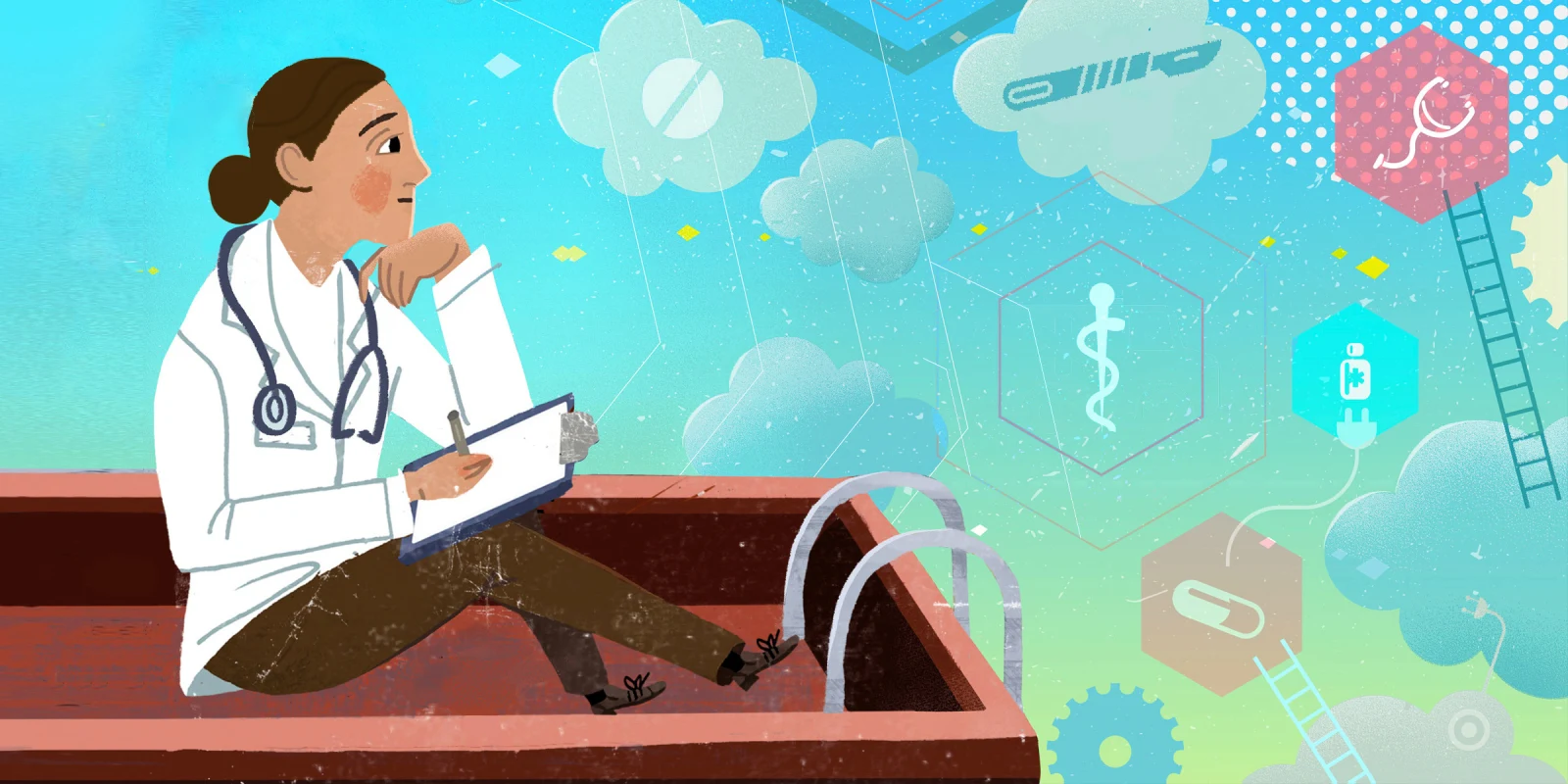
Image by Luciano Lozano / Getty