
According to a Doximity poll of 943 clinicians conducted in May 2026, the majority feel overworked. This includes 616 physicians, 82% of whom say they are overworked — close to the 81% recorded in 2023 and 85% recorded in 2025.
While the number of physicians feeling the strain of overwork has held roughly the same for years now, what's changed is what physicians say they're doing about it: 46% now say they’re considering early retirement as a result of overwork, up from 37% in 2025, 30% in 2023, and 21% in 2021.
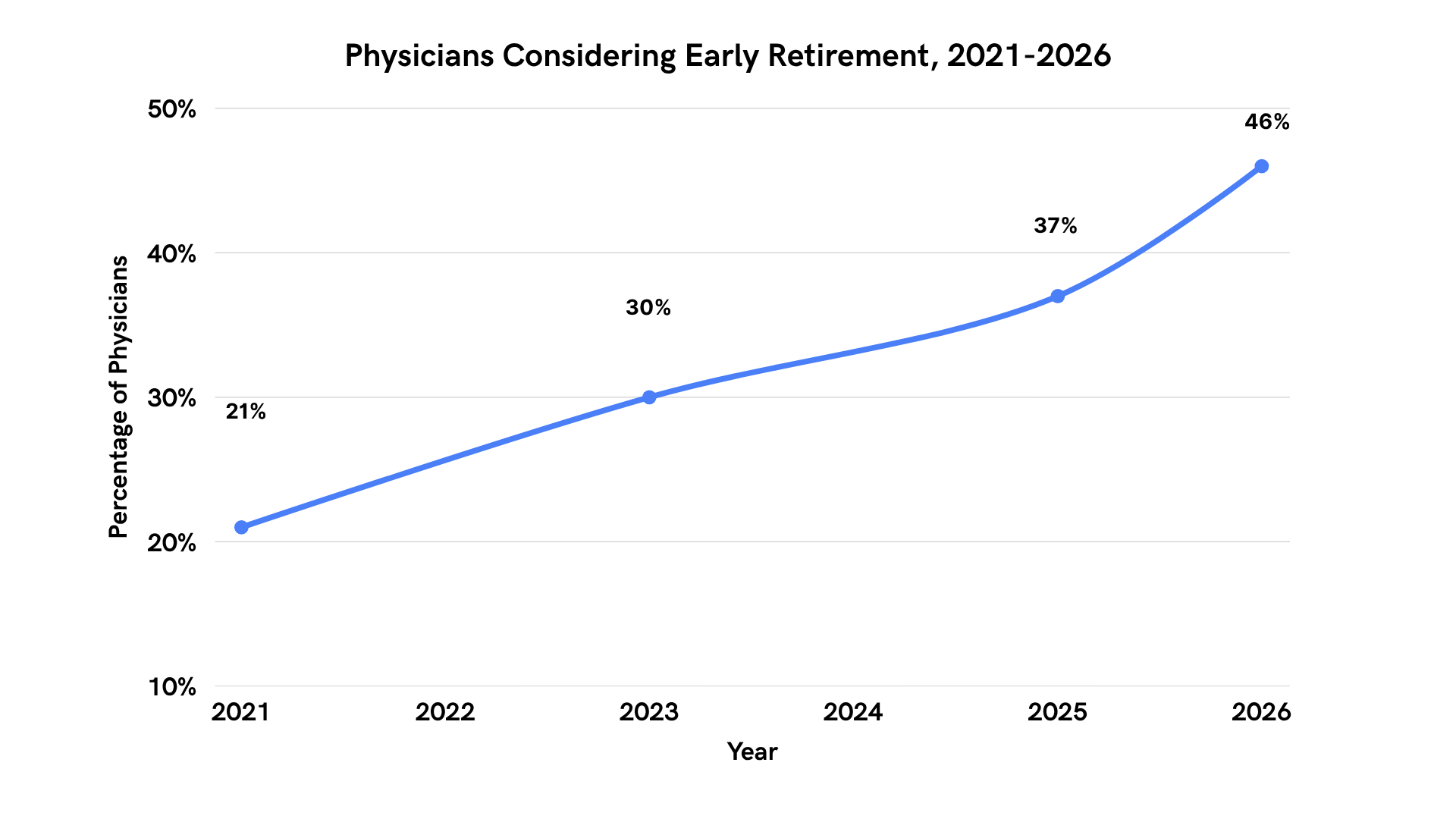
The rise has been steady across all four years of Doximity polling, possibly suggesting that physicians are working long hours and considering early retirement to lighten the load. Considering early retirement due to overwork has gone from a response roughly one in five overworked physicians gave to one that nearly half of physicians now give. While this may sound discouraging, there’s also been a marked increase in policy and workflow changes aimed at reducing clinician overwork and burnout.
Of course, overwork isn’t a new issue. Physicians surveyed in prior years have cited rising documentation and administrative burden, declining reimbursement relative to workload, staffing shortages, and a narrowing sense of autonomy within increasingly consolidated health systems. Researchers who study physician burnout have similarly pointed to work hours and system-level inefficiency as the primary drivers, rather than any deficit in individual resilience.
These systemic issues have been noticed, and organizations are taking action. In May 2022, U.S. Surgeon General Vivek Murthy issued an advisory on health worker burnout and laid out recommendations for health systems, insurers, technology companies, policymakers, and researchers to address its underlying drivers. This includes reducing administrative burdens, improving workplace culture and clinician access to mental health care, and expanding team-based models of care.
Demographic Differences
The shift toward early retirement shows up unevenly across gender and age. Among women physicians, early-retirement intent rose from 33% in 2023 to 54% in 2026, compared with a smaller rise among men, from 29% to 42%. In 2023, women physicians were also considerably more likely than men to say that they were considering a different career altogether (20% versus 12%); by 2026, that gap had narrowed to a single percentage point (11% versus 10%), as more women moved toward considering early retirement rather than a career change. The overall share of women physicians reporting overwork barely changed over the same period, holding at 88%.
Physicians are also considering early retirement at younger ages than in 2023. Physicians aged 45–49 who said they were considering early retirement nearly doubled, from 23% to 44%, and the 50–54 group rose from 35% to 56%. By 2026, physicians in their late 40s and 50s report early-retirement intent at levels close to those reported by physicians in their 60s three years earlier. This data is in line with expectations of upcoming doctor shortages, as projected in Health Resources and Services Administration’s (HRSA) National Center for Health Workforce Analysis.
A Shift in Primary Care
In prior years' polling, primary care physicians and surgical or procedural specialists have responded differently to overwork. Doximity's 2023 and 2025 polls found primary care physicians more likely to consider a different career altogether, while surgeons and other proceduralists were more likely to consider early retirement.
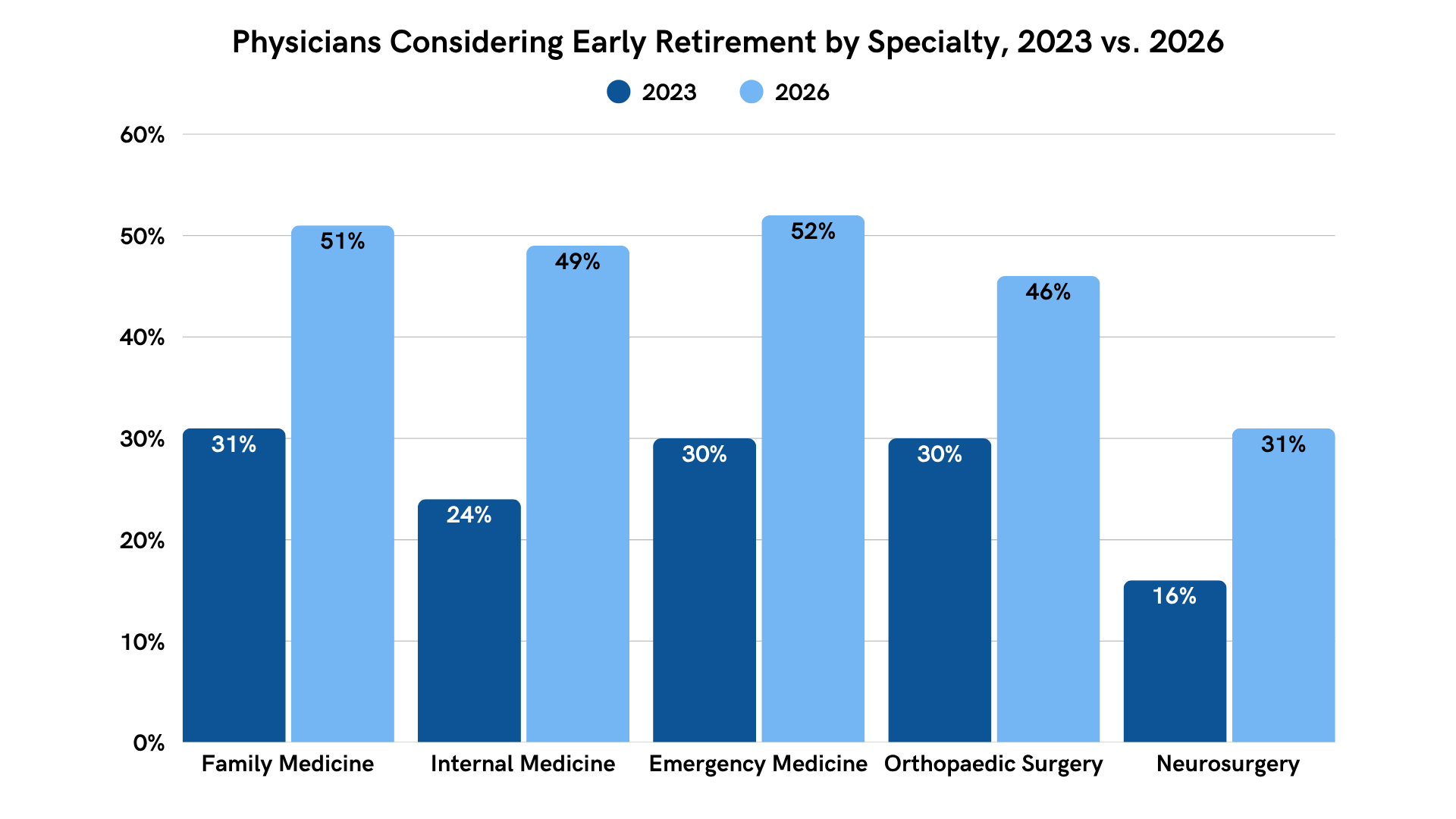
That distinction is smaller in this year’s data for those considering early retirement. Orthopaedic surgery and neurosurgery have historically shown the highest early-retirement rates in this poll, but from 2023 to 2026, each increased by only about 15%. By contrast, family medicine rose from 31% to 51%, internal medicine rose from 24% to 49%, and emergency medicine rose from 30% to 52%. All of these specialties experienced an increase of more than 20 percentage points.
Outlook
The year-over-year trend is clear: physicians are overworked. But the good news is that this issue has prompted a national response. The National Academy of Medicine 2023 Action Collaborative on Clinician Well-Being and Resilience brought together health systems, government agencies, and technology companies to reduce burnout. The American Medical Association (AMA) has published a series of free "STEPS Forward" modules addressing burnout at the individual and organizational level.
At the practice level, prior polling identified several specific strategies as having some effect on physician workload: team-based care models that redistribute administrative and clinical tasks across staff, ambient listening and AI-assisted documentation tools intended to reduce time spent on notes, and leadership practices aimed at giving physicians more input into decisions that affect their day-to-day work.
These strategies are working. Many health care organizations that have implemented AI-enabled documentation tools have reported a significant reduction in burden for physicians, NPs, and PAs. Every year, more licensing boards remove intrusive mental health questions, allowing more clinicians to seek help for mental illness without fear of jeopardizing their medical license. Even small changes in paperwork to reduce EHR burden are proving to reduce physicians' workload significantly.
These incremental fixes won't reverse the retirement numbers on their own, but they do show that health systems are testing specific changes and measuring results, rather than just documenting the strain of overwork.
What are some of the ways health systems are improving physician workload and work-life balance? Share your thoughts in the comment section.