
✍🏻 Add Your Signature Here
The authors invite every health professional who feels moved by this letter to add their name to it. When the public sign-on period closes, the letter and the full signatory list will be delivered to the Office of the President of the United States, Congressional leadership, NHTSA, and relevant state and local leaders.
We are surgeons, emergency physicians, nurses, PAs, rehabilitation specialists, intensivists, researchers, and more. We treat, study, and prevent motor vehicle injuries. Many of us hold the wounded in our hands. We are writing because the evidence now says that much of this suffering is preventable.
More than 100 Americans die in car crashes every day. Cyclists killed by red-light runners. Pedestrians killed by drunk drivers. Families killed by someone confusing the accelerator and the brake. In 2024, more than 39,000 people died on American roads. Crashes are the leading cause of death for Americans aged 16 to 24, accounting for nearly half of all fatalities in that age group. 5.1 million crash injuries required medical attention in 2023 alone. The combined economic and quality-of-life toll exceeds $1 trillion annually. That is larger than the entire Medicare budget.
No other cause of death at this scale would be met with this little urgency. As clinicians, we no longer accept it.
Safer infrastructure, better speed enforcement, impaired driving prevention, and public transit all save lives and deserve continued investment. Autonomous vehicles are not a replacement for those efforts, but their safety data has reached a threshold we cannot responsibly ignore.
A 2025 peer-reviewed study examined 56.7 million fully driverless miles on public roads and found an 85% reduction in serious-injury-or-worse crashes compared with human drivers on the same streets. Waymo’s most recent data release, covering more than 170 million miles, shows the results strengthening: a 92% reduction in serious-injury-or-worse crashes, with pedestrian injury crashes down 92% and cyclist crashes 85%, respectively. Intersection crashes, among the deadliest we see, fell 96%. If these results hold as deployment scales, the population-level effect could rival seatbelts or the decline of smoking. In medical research, when an intervention demonstrates this magnitude of benefit, we work to change the standard of care.
These results come from Waymo, which has been developing autonomous vehicles for a decade and a half. Other companies like Tesla and Zoox are also on this mission, but so far Waymo is the only one publishing the data clinicians need to evaluate health impacts: crash counts alongside miles driven, by location, against matched human baselines. Not every autonomous vehicle system is equivalent. That is precisely why we need standardized reporting.
We call on Congress and NHTSA to establish enhanced federal data-reporting requirements for all autonomous vehicle operators: crash rates per mile, geographic deployment data, validated benchmarks for comparison, and independent safety audits verified against police reports, insurance claims, and privacy-protected medical records. We need the denominator of specific miles driven, not just the number of crashes. And in the standard federal ranking of leading causes of death, motor vehicle fatalities aren’t listed as their own cause of death. They are buried inside “unintentional injuries.” We need that to change.
We call on state and local governments to replace unwarranted regulatory barriers with evidence-based frameworks that encourage deployment where the data supports it. New York, Massachusetts, Washington, Washington, D.C., and Minnesota are attempting to, or have effectively blocked autonomous vehicles despite this growing body of evidence. Whether an American gets seriously injured or worse should not depend on which side of a state line they drive on.
We are not workforce economists. But we do know that employment and financial security are inseparable from health, and that millions of Americans drive for a living. The transition ahead is real, and the scope of its workforce impact should be honestly assessed. Phased timelines and tangible planning for displaced workers should have started already and cannot wait any longer. We ask the experts and agencies with that knowledge and authority to treat workforce planning with the same seriousness we are asking everyone to bring to the safety evidence. Displacement that is foreseeable and unaddressed is its own kind of preventable harm.
We are not anti-car or anti-driver. We are anti-crash.
We drive and we teach our teenagers to drive. Some of us love to drive. We are not asking anyone to surrender their keys. We are asking that a technology demonstrating this capacity to prevent death not be stalled by regulatory inertia, unfamiliarity, or misplaced fear.
We want this done well, with transparent data and verification. Equitable access. Honest accounting of who bears the cost. We invite the automotive industry, labor leaders, personal injury attorneys, regulators, and skeptics to join us in this lane.
Almost everyone who signs this letter has held a steering wheel. Most have held bodies destroyed by cars. The question is whether we will act on the evidence we now have or keep accepting carnage at a scale we no longer must tolerate.
Signed by founding signatories,
Jonathan R. Slotkin, MD Danville, Pennsylvania
Eric J. Topol, MD La Jolla, California
Susan M. Baro, DO Danville, Pennsylvania
Alexander J. Blood, MD, MSc Boston, Massachusetts
Marissa A. Boeck, MD, MPH San Francisco, California
Shawna Butler, RN, MBA Austin, Texas
Richard H. Carmona, MD, MPH 17th Surgeon General of the United States, Tucson, Arizona
Garrett Chan, PhD, RN Los Angeles, California
Kathryn Connell, PhD, RN, CCRN Philadelphia, Pennsylvania
Terry E. Cropf, MPAS, PA-C Danville, Pennsylvania
Owais Durrani, DO Houston, Texas
Daniel Kraft, MD Menlo Park, California
Rhonda J. Manns, MBA, BSN, RN, CCM Houston, Texas
Rebecca L. Mitchell, MD San Francisco, California
Amit Phull, MD Washington, D.C.
Aartik Sarma, MD, MAS San Francisco, California
Gina Siddiqui, MD Washington, D.C.
Michelle Stephens, PhD, CNP, RN San Francisco, California
Christine T. Trankiem, MD Washington, D.C.
Graham Walker, MD San Francisco, California
✍🏻 Add Your Signature Here
Signatories to this letter do so in their individual capacity. Affiliations and titles are listed for identification purposes only and do not represent the views or endorsement of any employer, institution, or professional organization.
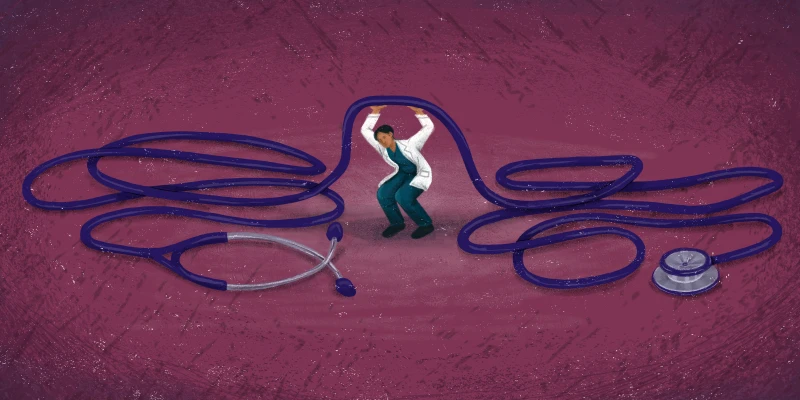
Illustration by April Brust